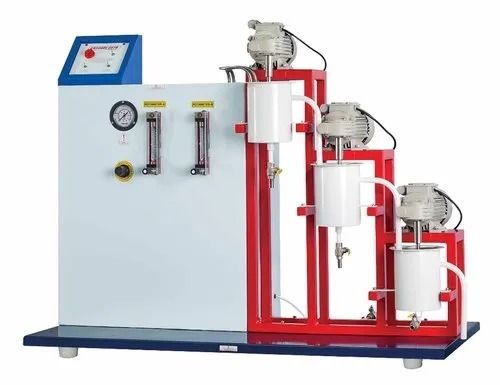
About CASCADE CONTINUOUSLY STIRRED TANK REACTOR (Compressed Air Feed System)
To study the performance of Cascade of three equal volumes CSTRs in series for the saponification of a reaction.
To draw the performance chart for the reactor system and evaluate the reaction rate constant at ambient conditions.
Product Specifications
Equipment Materials SS
Power 1500 Watt (w)
Usage For College Labs
Voltage 230 Volt (v)
Material Metal
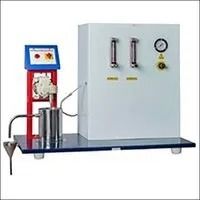
Advanced Cascade Reactor DesignThis equipment integrates three glass reactors arranged in series for an authentic cascade CSTR configuration, ideal for in-depth kinetic and reactor design experiments. The transparency of borosilicate vessels and the inclusion of stainless steel supports combine robustness with optimal chemical resistance and visibility, facilitating direct observation of ongoing reactions and system behavior.
Precise Control and MeasurementVariable-speed magnetic or mechanical stirrers, PID-based temperature and stirrer controls, and compressed air feed precisely managed via rotameters and needle valves deliver consistent, reproducible conditions. Digital panel meters offer accurate, real-time data for pH and temperature, making this setup perfect for applications needing exact environmental monitoring.
Safety and ComplianceFactory-calibrated for accuracy, the system features overtemperature cut-off, pressure relief valves, and complies with standard laboratory safety requirements. The anodized aluminium frame and bench-top mounting ensure safe, enduring operation, while the system's compact footprint suits most institutional laboratory spaces.
FAQ's of CASCADE CONTINUOUSLY STIRRED TANK REACTOR (Compressed Air Feed System):
Q: How is compressed air regulated in the cascade CSTR system?
A: Compressed air is regulated using rotameters for visual flow indication and needle valves for fine adjustment. This ensures consistent, precise air feed into each reactor vessel for controlled reaction conditions.
Q: What is the primary benefit of using a cascade arrangement with three reactors?
A: A cascade arrangement enhances process efficiency and accuracy by allowing for sequential reaction stages. This setup mimics industrial processes, enabling detailed study of reaction kinetics and optimizing reactor design parameters in laboratory conditions.
Q: When should the sampling ports on each reactor be used?
A: Sampling ports are typically utilized during or after reactions to collect samples for analysis. This allows for monitoring reaction progress, verifying concentrations, or calibrating experimental parameters, without interrupting the process.
Q: Where can the Cascade CSTR system be installed and used?
A: This equipment is designed for bench-top installation in academic or research laboratories. It is suitable for use in chemical engineering departments, research institutes, or any facility conducting reactor design or kinetics studies.
Q: What process does the Cascade CSTR simulate and why is this important?
A: The system simulates continuous-flow, multi-stage chemical reactions as seen in industrial CSTRs. This provides researchers and students with practical insights into scaling, mixing, and kinetics, essential for both academic demonstration and real-world process optimization.
Q: How does the variable speed stirrer enhance experimental capabilities?
A: The magnetic/mechanical variable-speed stirrer allows precise adjustment of mixing intensity (up to 500 rpm), ensuring uniform reactant distribution and efficient heat/mass transfer, which is crucial for reproducible kinetic studies and performance evaluation.
Q: What are the main safety features included with this reactor system?
A: Safety is prioritized with overtemperature cut-off mechanisms and pressure relief valves for each vessel, reducing the risk of overheating or overpressurization. These safeguards ensure reliable operation and protect both users and equipment during experimental runs.

 Send Inquiry





 Send Inquiry

 Send Inquiry