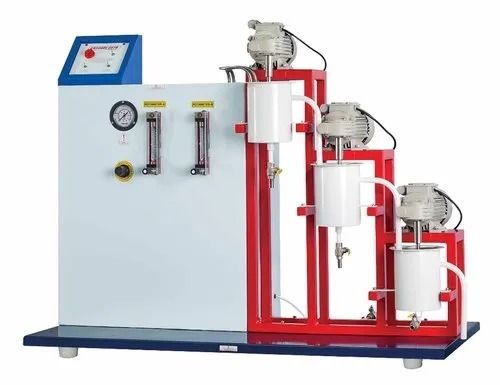
About ISOTHERMAL CONTINUOUSLY (CompressedAir Feed System) STIRRED TANK REACTOR (
Sponification Reaction study in Isothermal CSTR.
To determine the Reaction Rate Constant and the effect of temperature on it
Product Specifications
Temperature Range 45 Celsius (oC)
Material Metal
Display Type Digital
Power 500 Watt (w)
Usage Laboratory
Voltage 230 Volt (v)
Equipment Materials Brass
Superior Control and SafetyThe reactor is equipped with precise digital PID temperature control using a PT100 RTD sensor, achieving a rapid sensor response of less than one second. It features over-temperature and over-pressure protection, ensuring safe operation even under variable reaction conditions. The thermal insulation jacket maintains stable temperatures, essential for accurate results.
Versatile Applications and Chemical CompatibilityDesigned for both batch and continuous processing, this reactor is suitable for wall-to-wall chemical studies, mixing, and upscaling research. Its robust construction from borosilicate glass and stainless steel fittings makes it compatible with acidic, basic, and neutral solutions, ideal for enzyme kinetics, synthesis, and fermentation.
Efficient Operation and Easy MaintenanceFeaturing an overhead variable-speed motor and peristaltic feed pump, the unit enables fine-tuned control over agitation and reagent dosing. The removable vessel simplifies cleaning, while the digital LED display enables real-time monitoring of critical parameters. Optional digital data logging and analog/digital interfaces streamline integration into lab systems.
FAQs of ISOTHERMAL CONTINUOUSLY (CompressedAir Feed System) STIRRED TANK REACTOR (:
Q: How does the isothermal CSTR maintain precise temperature control during reactions?
A: The isothermal CSTR utilizes a PT100 RTD sensor integrated with a digital PID controller to provide accurate temperature regulation within the range of 0 to 150C. The thermal insulation jacket helps to maintain isothermal conditions, minimizing heat loss and ensuring temperature stability for sensitive reaction protocols.
Q: What types of reactions and processes can be performed in this reactor system?
A: This reactor supports a variety of chemical processes, including aerobic fermentation, chemical synthesis, and enzyme kinetics. Its robust construction and continuous operation capabilities make it suitable for research, laboratory analysis, mixing studies, and scale-up investigations.
Q: When should I use the compressed air feed system and how is it operated?
A: The compressed air feed system is ideal for processes requiring aeration, such as aerobic fermentation or oxidation reactions. Air is introduced through a sparger, with precise control up to 8 bar, ensuring optimal oxygen transfer and mixing efficiency throughout continuous or batch operations.
Q: Where can this CSTR be utilized effectively?
A: This isothermal reactor is suitable for a range of environments, including academic research labs, industrial pilot facilities, and process development centers. Its floor-stand design and compatibility with 220V AC, 50 Hz power make it convenient for a multitude of locations, especially in India.
Q: What are the maintenance and cleaning steps for the reactor?
A: The vessel is fully removable, enabling straightforward access for cleaning after each experiment. The stainless steel fittings resist corrosion, and periodic calibration or cleaning of sensors (temperature and pressure) ensures long-term accuracy and safety.
Q: How does the digital control system benefit process monitoring and data collection?
A: The digital PID controller offers real-time parameter adjustment with high precision. The system supports a digital LED display for instant feedback, while optional analog/digital (and USB) interfaces allow seamless data logging and integration with laboratory information management systems.

 Send Inquiry




 Send Inquiry

 Send Inquiry