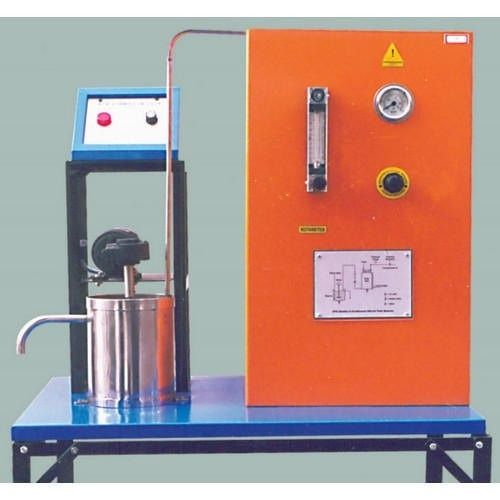
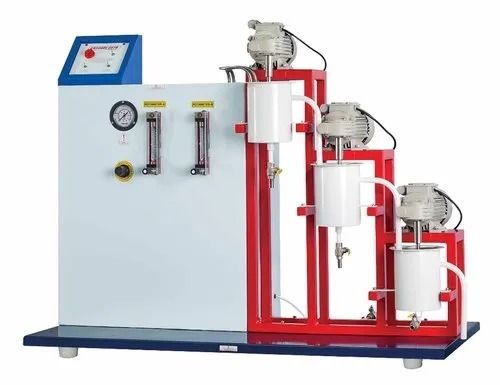
About RTD STUDIES IN CONTINUOUSLY STIRRED TANK REACTOR (Peristaltic Pump Feed System)
To plot the RTD curve for a CSTR. Using pulse tracer.
To determine the Dispersion No
Product Specification
Equipment Materials SS
Voltage 220 Volt (v)
Color Multicolor
Power 500 Watt (w)
Material Metal
Usage For College and University
Precision-Controlled RTD ExperimentsThis apparatus is engineered for accurate residence time distribution studies with a variable speed peristaltic pump and adjustable stirrer, ensuring consistent and reproducible mixing. Its transparent borosilicate reactor allows for direct observation and precise control of experimental parameters, optimizing results for academic research and process development.
Comprehensive Safety and Usability FeaturesSafety is at the forefront, with shock-proof, fuse-protected, and chemically resistant construction. The easy-to-clean, detachable components allow for simple maintenance, while the integrated sampling ports facilitate seamless tracer injections and real-time measurements, making this apparatus both user-friendly and reliable.
Flexible Data Acquisition and AnalysisOffering optional provisions for computer data acquisition and dedicated RTD analysis software, this system supports modern data-driven research. The digital display, high accuracy, and fast response times streamline measurement, catering to academic institutions and research facilities aiming for detailed kinetic and hydrodynamic studies.
FAQ's of RTD STUDIES IN CONTINUOUSLY STIRRED TANK REACTOR (Peristaltic Pump Feed System):
Q: How is a tracer introduced and measured during an RTD experiment in this apparatus?
A: A tracer, such as dye or salt, is injected through the integrated sampling ports allowing for easy and precise introduction to the reactor. The system supports real-time measurement via compatible detection methods such as colorimetry or conductivity, enabling accurate tracking of concentration changes throughout the experiment.
Q: What are the benefits of using a borosilicate glass reactor vessel in RTD studies?
A: Borosilicate glass provides chemical resistance, durability, and transparency, allowing for safe operation with various chemicals and direct visual observation of the stirring and mixing processes, which is essential for academic and research settings.
Q: When should the equipment be calibrated and what is the process?
A: Calibration should be performed manually using standard solutions before starting a new series of experiments or when transitioning between tracer types. This ensures measurement accuracy and consistency across runs.
Q: Where can this RTD study apparatus be used most effectively?
A: The system is best suited for laboratory settings in academic institutions, research centers, and process engineering labs focused on chemical engineering education, kinetic studies, and scale-up process development.
Q: How does adjustable stirrer speed impact RTD results in the reactor?
A: Adjustable stirrer speed (500-2000 RPM) allows users to manipulate the mixing intensity within the reactor, directly influencing residence time distribution and ensuring optimal conditions for different experiments and analytical requirements.
Q: What is the benefit of the semi-automatic control mode for laboratory studies?
A: The semi-automatic operation provides precise manual control while supporting repeatability and safety. This flexibility suits both routine academic experiments and advanced research requiring tailored operational parameters.
Q: What are the usage and maintenance requirements for this RTD studies apparatus?
A: Regular cleaning is straightforward due to detachable reactor components. The system should be used on a stable benchtop, supplied with 230V AC, and operated within ambient conditions (15C-40C). Follow standard laboratory protocols and manufacturer guidelines for prolonged accuracy and safety.

 Send Inquiry




 Send Inquiry

 Send Inquiry