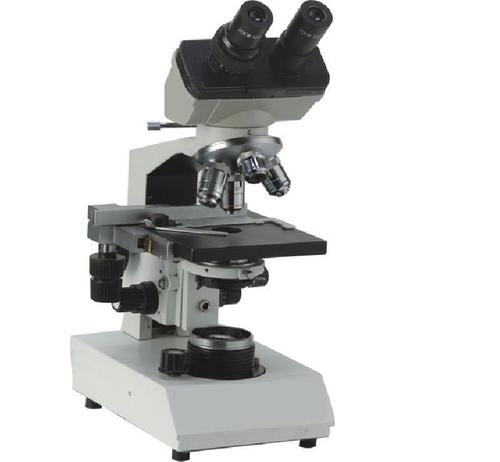
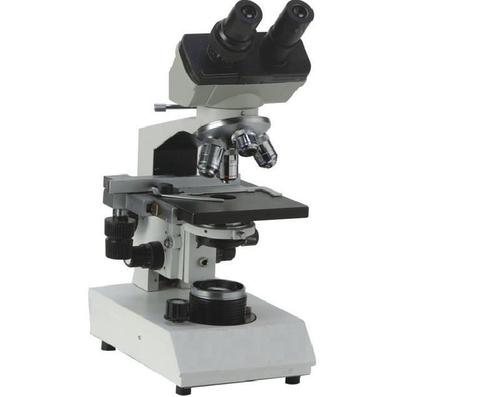
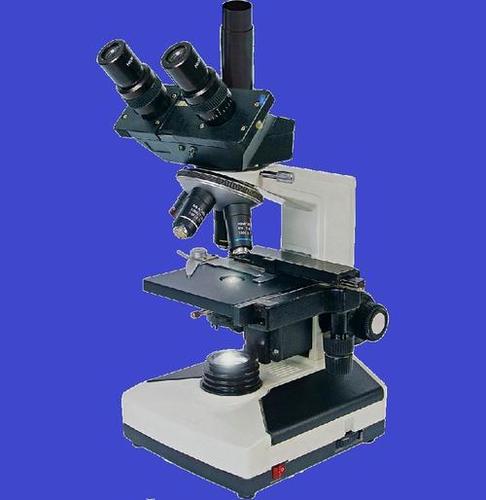
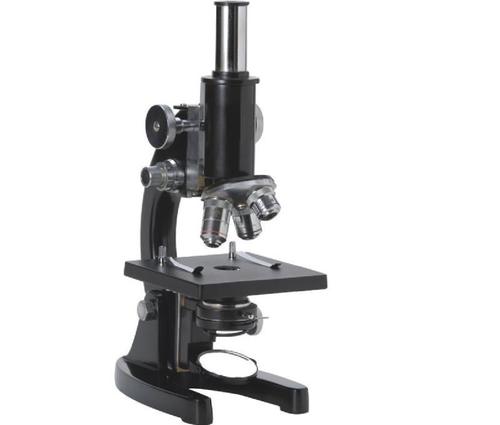
About Trinocular Research Microscope
Stand : Rigid & Heavy single mold aluminum die-cast stand. Observation Head : BINOCULAR head inclined at 45 and rotatable in 360 fitted with highest quality prism to ensure highly accurate collimation for stain free observation. Eyepiece : KEOWA H6x and HKW 10x (paired) focusable, lockable, anti-fungal eyepieces with foldable eyeguards. Nosepiece : QUADRUPLE ball bearing revolving nose piece with POSITIVE click stop & rubber grip. Objectives : KEOWA Achromatic objectives 4x/NA 0.10, 10x/NA 0.25, 40x/NA 0.65(SL) and 100x/NA 1.25(SL) Oil imm. Stage: RECTANGULAR stage of size 120x140mm with graduated low positioned co-axial controls for X & Y movement. Focusing : SEPARATE coarse and highly sensitive graduated fine focusing knobs reading upto 0.002mm and Slide Safety topper. Condenser : Substage condenser NA 1.25 fitted with iris diaphragm and swing out filter holder with blue filter moving up and down through rack and pinion mechanism. Illumination : Halogen 6V-20W illumination with central knobs for LOW/MED./ HIGH illumination. Upto 2,000 hours of Halogen Lamp life. Universal input 100V - 240V AC, 50/60Hz. Packaging contents : Packed in shockproof Styrofoam molded box or in a plywood cabinet having provision for placing eyepieces, objectives. Nylon Dust cover. Detachable power cord and 3 pin-plug. Accessories (optional) Dark field and phase contrast kits. Warranty Information 2 Years parts. 3 years KEOWA optics
Precision Optics for Advanced ResearchEquipped with an infinity-corrected optical system, this microscope ensures sharp, high-resolution images at magnifications ranging from 40X to 1000X. Its achromatic objectives and wide-field eyepieces support detailed viewing, making it ideal for rigorous academic and laboratory work.
Durable and User-Friendly ConstructionThe metal die-cast body guarantees durability, while ergonomic design features such as a 45 inclined, 360 rotatable trinocular head, and double-layer mechanical stage enhance user comfort. Anti-fungal optics and a stain-resistant finish ensure minimal maintenance and long-lasting performance.
Versatile Illumination and Power OptionsEnjoy flexibility with built-in adjustable LED or halogen illumination and a wide voltage tolerance (90-240V), accommodating diverse laboratory settings. The microscope comes supplied with essential accessories including a dust cover, spare parts, and camera-compatible features for imaging.
FAQs of Trinocular Research Microscope :
Q: How do I attach a digital camera to the trinocular head of this microscope?
A: The microscopes trinocular head includes a dedicated camera port compatible with various adapters. Simply connect your camera via the appropriate adapter, ensuring it matches the trinocular tube specification, to capture or record images and videos directly through the optical path.
Q: What applications is this microscope best suited for?
A: This model is ideal for pathology, biological research, academic studies, and laboratory analysis. Its high magnification range, ergonomic build, and coaxial focusing allow for precise sample observation and documentation in educational and professional settings.
Q: When should I use the oil immersion objective?
A: The 100X(SL) objective is designed for oil immersion. Use it when examining specimens requiring high magnification and fine detail, such as cellular structures in pathological slides. Always use immersion oil for proper resolution and avoid damage by cleaning thoroughly after use.
Q: Where can I adjust the interpupillary distance and diopter settings?
A: Interpupillary distance can be adjusted between 55-75mm on the binocular eyepiece tubes, ensuring comfort for different users. Diopter adjustment is available on the left eyepiece, enabling compensation for vision differences between eyes.
Q: What benefits does the infinity-corrected optical system offer?
A: Infinity-corrected optics minimize aberrations and provide crisp, flat-field images across the field of view. This system supports advanced imaging, compatibility with additional accessories, and consistent high-quality observation needed in research environments.
Q: How do I maintain the microscope for optimal longevity?
A: Keep the microscope covered with the supplied dust cover when not in use, periodically clean the optics with proper lens tissue, and avoid direct contact with dust or reagents. Regularly check and replace consumables like bulbs or fuses as necessary.

 Send Inquiry



 Send Inquiry

 Send Inquiry