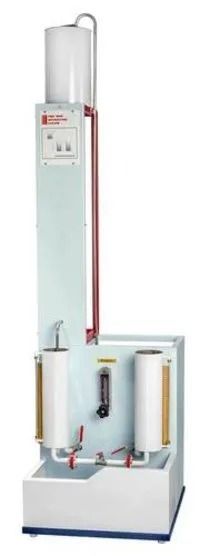
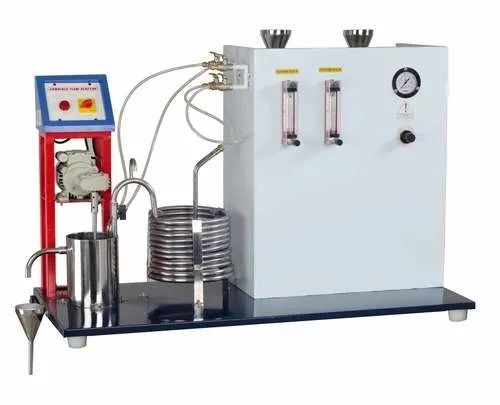
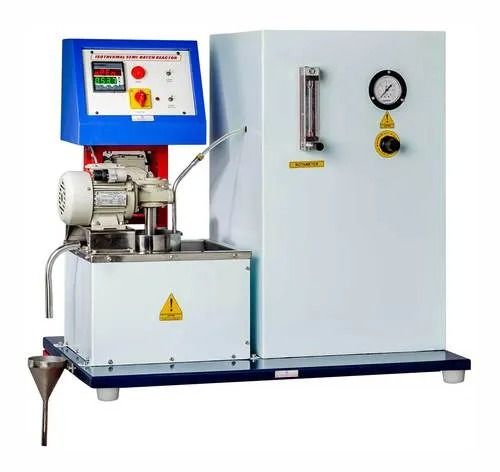
About RTD STUDIES IN PACKED BED REACTOR (Peristaltic Pump Feed System)
To plot the RTD curve for the Packed Bed Reactor.
To determine the Dispersion No.
Specification
Reactor Column: Material Borosilicate Glass Capacity 1.2 Ltrs (approx.)
Packing: Rasching Rings, Material Borosilicate Glass. Size 8-10mm (approx)
Feed Tank: Material Stainless Steel, Capacity 20 Ltrs.
Piping: Stainless Steel and Silicon Pipe.
Flow Measurement: Peristaltic Pumps, 1No. (For water).
Stop Watch: Electronic Arrangement is done to inject the tracer into the lower end of the reactor.
Transparent Design for Visual LearningThe reactor's transparent borosilicate glass or clear acrylic column enables easy visual monitoring of flow patterns and tracer movement during RTD experiments. This real-time observation enhances understanding of flow dynamics within a packed bed, making it an ideal tool for teaching and demonstration in academic settings.
Flexible Flow Rate and Tracer InjectionWith a peristaltic pump capable of finely tuned flow rates from 10 to 150 mL/min, users can simulate a wide range of operating conditions. The dedicated port for quick tracer injection makes it straightforward to conduct RTD experiments and collect data for in-depth analysis.
Comprehensive Sampling and Data LoggingMultiple effluent sampling ports make it easy to collect samples at different times, essential for accurate RTD curve construction. An optional data acquisition system ensures compatibility for digital logging and advanced analytics, supporting thorough laboratory experimentation.
FAQ's of RTD STUDIES IN PACKED BED REACTOR (Peristaltic Pump Feed System):
Q: How do I set up and operate the RTD Studies in Packed Bed Reactor?
A: Installation is straightforward-place the tabletop unit in a 0.6m 0.3m area, fill the reactor column with the provided packing material, and connect the peristaltic pump to your feed solution. Use the digital or manual control panel to adjust the flow rate. Tracer injections are performed via the dedicated input port, and samples are collected from the multiple output ports as specified in the instruction manual.
Q: What is the purpose of using glass beads or ceramic saddles as packing material?
A: Glass beads and ceramic saddles offer ideal surface areas and flow characteristics for laboratory packed bed reactor studies. They facilitate even distribution of fluids and support accurate RTD analysis by mimicking industrial reactor conditions, all while allowing visual observation through the transparent column.
Q: When should I use the quick tracer pulse injection method?
A: The tracer pulse injection method is used at the start of each RTD experiment. It allows a quick, concentrated pulse of tracer to be introduced, making it possible to monitor and analyze the time distribution of the tracer as it moves through the packed bed, essential for determining reactor performance.
Q: Where can sampling be conducted during an experiment?
A: Sampling ports are strategically located at different positions on the reactor column's effluent line. This enables collection of liquid samples at various times, allowing for detailed measurement of the tracer concentration and construction of precise RTD profiles.
Q: What process control options are available for this reactor setup?
A: The reactor features both manual and digital control panels, providing flexibility in operation. Users can adjust the flow rate, monitor digital timing, and manage the test cycle, all tailored to the needs of RTD analysis or specific experimental requirements.
Q: How accurate and reliable is the data collected during RTD studies?
A: With an accuracy of 1% of full scale and a resolution of 0.1 min, the RTD-01-PB delivers highly reliable data. The integrated digital display provides instantaneous timing and process visibility, and compatibility with data acquisition systems offers seamless, verifiable logging for rigorous academic research.
Q: What are the main benefits of using this equipment in a chemical engineering lab?
A: This setup offers clear learning value through visual operation, precise process control, safe handling with overload and surge protection, and easy data collection. Students and researchers gain hands-on experience in reactor dynamics, directly observing the effects of flow rate, packing, and tracer injection in RTD studies.

 Send Inquiry




 Send Inquiry

 Send Inquiry