About Reynold S Apparatus
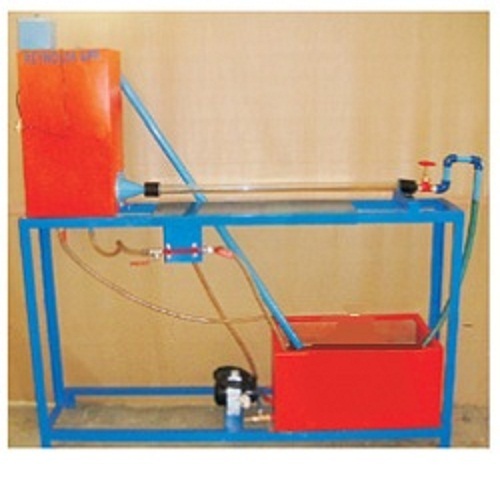
The Set-up is designed to verify Reynolds Apparatus experimentally. The Apparatus consists of a glass tube which one end having bell mouth entrance connected to a water tank. At the other end of the glass tube a cock is provided to vary the rate of flow. Flow rate of water can be measured with the help of Measuring Cylinder and Stop Watch, supplied with the set-up. A capillary tube is introduced centrally in the bell mouth. To this tube dye is fed from a small container, placed at the top of Constant head Tank, through polythene tubing.Comprehensive Flow VisualizationWith its borosilicate glass tube and integrated dye injection system, the REY-101 offers clear, transparent flow visualization, allowing users to directly observe laminar and turbulent flow transitions. The analog display and rotameter ensure precise flow measurement, providing a practical and engaging way to study fluid behavior in real time.
Adaptable Design and Easy OperationThe Reynold S Apparatus is built for flexibility and convenience: its castor wheels allow easy movement, while the powder-coated mild steel chassis provides durability for intensive lab use. Designed for benchtop or floor-mounted installation, REY-101 seamlessly adapts to different laboratory layouts and requirements.
Accurate and Reliable MeasurementsEngineered for both educational and research environments, the REY-101 delivers reliable performance with an accuracy of 2%. The centrifugal pump and precision control needle valve allow careful adjustment of flow rates, while the equipment covers a broad Reynolds number range, supporting a variety of experimental setups for in-depth fluid mechanics studies.
FAQs of Reynold S Apparatus:
Q: How does the dye injection system in the Reynold S Apparatus work?
A: The integrated syringe-based dye injection system introduces dye into the flow, making transitions between laminar and turbulent flow regimes visible within the borosilicate glass tube. This feature enables users to study and differentiate flow patterns clearly during experiments.
Q: What is the primary use of the Reynold S Apparatus in engineering labs?
A: The apparatus is primarily used to determine the Reynolds number and study fluid flow under varying conditions. It helps students and researchers observe, measure, and understand flow behavior, including the transition from laminar to turbulent flow.
Q: When should the precision control needle valve be adjusted during an experiment?
A: The control needle valve should be adjusted prior to and during an experiment to precisely control the flow rate. This adjustment is essential for replicating different flow conditions and accurately determining Reynolds number.
Q: Where can the REY-101 apparatus be installed for optimal use?
A: The REY-101 is designed for versatile placement. It can be installed on a benchtop or directly on the floor, thanks to its compact size and sturdy construction with castor wheels for mobility. This flexibility makes it suitable for a diverse range of laboratory settings.
Q: What is the recommended process for measuring Reynolds number with this equipment?
A: Begin by filling the stainless steel tank with water and setting up the apparatus. Use the centrifugal pump and adjust the flow using the precision needle valve. Inject dye via the syringe system, observe the flow patterns, and record readings from the rotameter and analog display to calculate the Reynolds number.
Q: Who benefits most from using the Reynold S Apparatus?
A: The apparatus is especially beneficial for engineering educators, students, researchers, and laboratory technicians who need to study fluid dynamics, observe flow regimes, and understand hydrodynamic principles through hands-on experiments.
Q: What are the main benefits of using this apparatus for fluid flow studies?
A: Key benefits include direct visualization of flow patterns, precise control and measurement of flow rates, robust construction for frequent laboratory use, and adaptable installation. Its accurate and reliable measurements enhance the understanding of fluid dynamics fundamentals.

 Send Inquiry



 Send Inquiry

 Send Inquiry