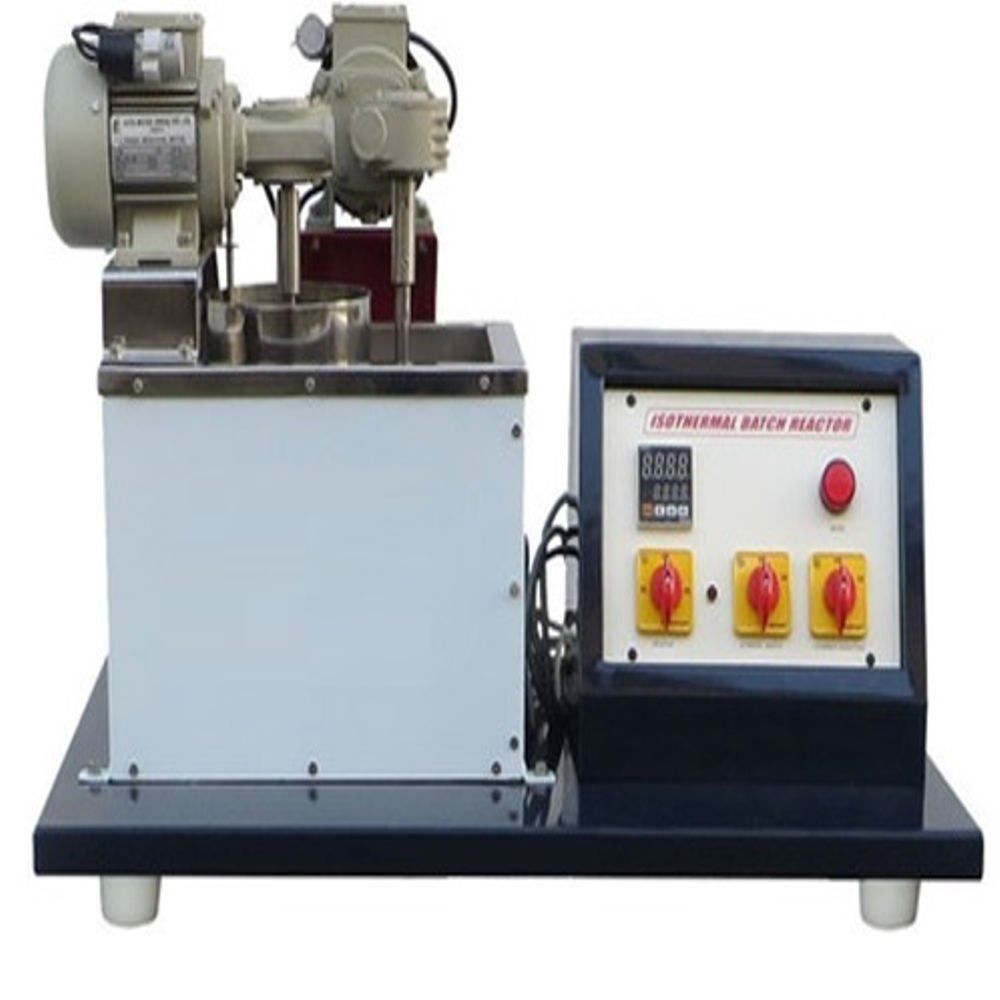
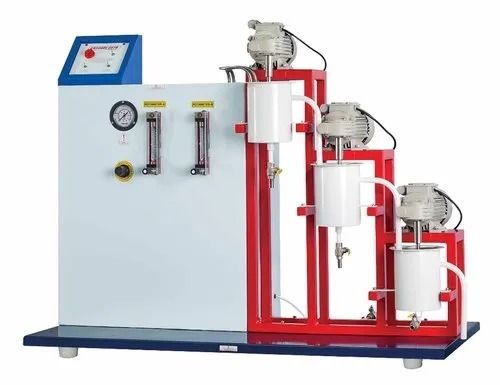
About ISOTHERMAL BATCH REACTOR
Scope of Study:
To study the progress of a chemical reaction and determine the kinetic parameters.
To determine the effect of temperature on Reaction Rate Constant.
Reactor: Material Stainless Steel, Volume 2 Ltrs. Approx.
Water Bath: Material Stainless Steel, Double wall insulated with Ceramic wool.
Heater: Nichrome wire Heater Stirrer 2Nos Stainless Steel Impeller and a shaft coupled with FHP motor. Temp. Sensor: RTD PT100 type
Versatile Control for Laboratory ExperimentsThis isothermal batch reactor is designed to streamline laboratory chemical reactions, offering both magnetic and mechanical stirring with a speed range of 0 to 1000 RPM. The reactors PID controller enables precise temperature control from ambient up to 90C, with a rapid sensor response and 0.5C accuracy. Its compact benchtop form factor and insulated jacket ensure safe, reliable operation for academic and industrial labs alike.
Advanced Construction and Safety FeaturesBuilt from borosilicate glass or stainless steel, the reactor ensures chemical compatibility and high durability. The protective glass wool insulation on the vessel jacket and safety features like pressure relief valves and over-temperature cut-off provide a secure working environment. The reactors viewing section and sampling port allow real-time monitoring and sampling during reactions, enhancing experimental control.
Comprehensive Data Monitoring and ConnectivityWith its digital LED display, optional data logging (USB or PC interface), and analog/digital input/output options, this batch reactor simplifies monitoring and recording of process parameters. The system supports single-batch operations with a working volume range suited to diverse experimental needs, making it an ideal educational and research tool.
FAQs of ISOTHERMAL BATCH REACTOR:
Q: How is temperature controlled and monitored in the isothermal batch reactor?
A: Temperature in the reactor is regulated using a manual or digital PID controller, with feedback provided by a PT100 thermocouple. The digital LED display allows accurate temperature readings, with a measurement range of 0100C and an accuracy of 0.5C. The jacketed vessel, combined with glass wool insulation, enhances thermal stability.
Q: What types of laboratory reactions can this reactor be used for?
A: The isothermal batch reactor is suitable for a wide range of chemical reaction engineering studies, educational demonstrations, and lab-scale reactions. Its construction materials, control options, and safety features make it ideal for tasks that require precise temperature and stirring control, such as kinetic studies and process optimization.
Q: When is it beneficial to use the magnetic or mechanical stirrer, and how is the speed adjusted?
A: You can select either magnetic or mechanical stirring based on the viscosity of your reaction mixture and the required agitation. Stirrer speed is adjustable from 0 to 1000 RPM, either manually or via digital control, offering optimal mixing conditions for various types of reactions and specimen sizes.
Q: Where can the isothermal batch reactor be installed and used most effectively?
A: This reactor is designed as a laboratory benchtop model, making it suitable for university labs, research institutions, or industrial R&D departments. Its compact size and robust construction allow for safe and convenient use in educational, demonstration, or research settings.
Q: What is the stepwise process for operating this reactor for a batch experiment?
A: Begin by charging the vessel with reactants (0.53 L). Set parameters such as temperature, stirring speed, and controller mode (manual/digital PID). Activate stirring, enable heating through the jacket, and monitor conditions on the digital display. Samples can be withdrawn via the included sampling port. Data can be recorded instantly, and safety features protect the system throughout the run.
Q: How does the reactor enhance experimental safety and data reliability?
A: Equipped with a pressure relief valve and over-temperature cut-off, the reactor safeguards against operational hazards. Its instantaneous digital sensor response and optional data logging ensure reliable tracking of process variables, supporting data integrity and repeatability.
Q: What are the key benefits of using this isothermal batch reactor for laboratory studies?
A: The reactor provides precise control of temperature and agitation, flexibility in specimen size (0.53 L), real-time monitoring, and robust safety mechanisms. These features enable efficient, reproducible laboratory experiments, helping researchers and students gain accurate insights into reaction kinetics and engineering principles.

 Send Inquiry



 Send Inquiry

 Send Inquiry