About Venturimeter Orificemeter calibration setup For Fluid Mechanics Lab
Venturimeter & Orificemeter calibration setup
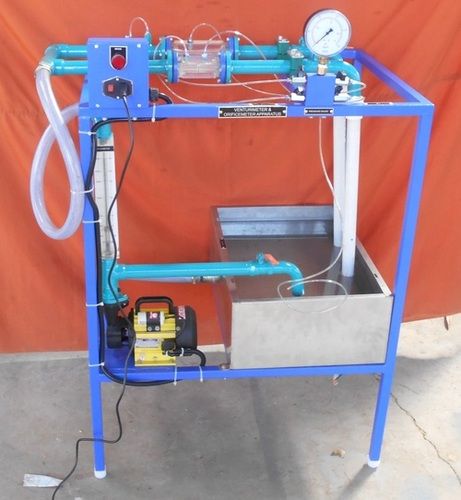
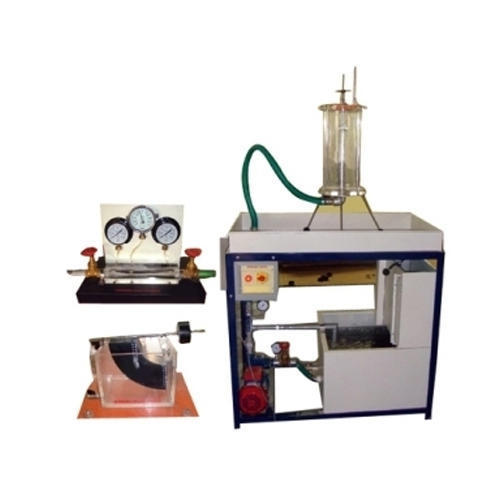
1) The apparatus consists of two pipelines emerging out from a common manifold. One pipeline contains a venturimeter and second contains an orifice. The pressure tappings from the venturimeter and orificemeter are taken to differential manometer to measure pressure difference.
2) The venturimeter and orificemeter are connected in parallel and anyone of them can be put in operation by operating valves provided at the downstream. These valves can also regulate the flow.
3) Present setup is delf contained water recirculating unit , providedwith sump tank and centrifugal pump.
4) Flow control valve and by-pass valve are fitted in water line to conduct the experiment on different flow rate.
5) Flow rate of water is measured with the help of measuring tank and stop watch.
6) Venturimeter material clear acrylic compatible 1 dia Pipe.
7) Orificemeter- material clear acrylic compatible 1 dia Pipe.
8) Water circulation FHP Crompton make
9) Flow measurement- using measuring tank. Capacity-25 Ltrs.
10) Sump tank 50 Ltrs
11) Stop watch- electronic
12) Tanks will be made of SS304
13) Good quality painted structure
Reliable Flow Measurement ApparatusDesigned for indoor laboratory use, this setup offers high-accuracy calibration for both Venturimeter and Orificemeter using clean water. With an ambient temperature range of 5C to 50C and overload protection, it ensures safe operation in educational and research environments. The powder-coated finish and corrosion-resistant acrylic water tank guarantee durability. Modular construction makes maintenance and cleaning straightforward, minimizing downtime during lab sessions.
Precision Control and Easy OperationA precision control valve enables accurate adjustment of flow rates during experiments while the integrated ON/OFF switch simplifies usage. Flexible hoses with quick couplings allow rapid setup and changes. The manometer's calibrated scale in mm and LPM, plus reliable indicator glass, help students and professionals achieve repeatable and consistent results in fluid flow analyses.
FAQ's of Venturimeter Orificemeter calibration setup For Fluid Mechanics Lab:
Q: How do I calibrate the Venturimeter and Orificemeter using this setup?
A: Calibration involves connecting the test meters to the flexible hose system, regulating water flow with the precision control valve, and observing manometer readings in mm or LPM. Accurate calibration is ensured by comparing these readings with known standards provided in IS: 5549.
Q: What is the recommended liquid for testing and calibration?
A: Clean water is used in this apparatus. The acrylic tank is designed for water, and all components are compatible with standard laboratory water quality for reliable, repeatable tests.
Q: When should I perform routine maintenance on the equipment?
A: Routine maintenance is minimal but should be done after every experimental session. It primarily includes cleaning the acrylic tank and checking connections for leaks. Due to its modular design and high-quality materials, regular maintenance is quick and hassle-free.
Q: Where should I install this calibration setup?
A: This apparatus is best suited for indoor laboratory settings, where it can be mounted on the floor using the provided supports. Ensure the installation area meets ambient temperature requirements and allows safe access to power supply and water sources.
Q: What safety features are included in the system?
A: The setup is equipped with overload protection for the pump motor and operates below a noise level of 68 dB. Its corrosion-resistant construction and secure couplings also contribute to safe operation.
Q: What is the process for changing between Venturimeter and Orificemeter testing?
A: Switching between tests is straightforward with quick-coupling hoses and modular core components. Simply disconnect and reconnect the relevant meter, adjust the control valves, and begin measurement.
Q: What are the key benefits of using this calibration apparatus in an educational lab?
A: It offers high measurement accuracy, easy maintenance, plug & play installation, and straightforward operation. Its robust safety, modularity, and rapid setup make it ideal for teaching fluid mechanics principles and conducting reliable experiments.

 Send Inquiry



 Send Inquiry

 Send Inquiry