About Study Of Flow Measurement Devices
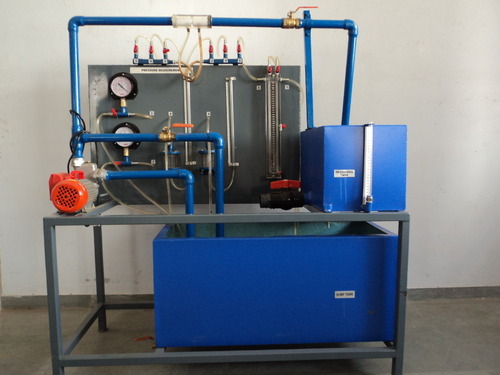
Measurement of liquid flow is required at various places and for various purposes. Different types of flow measuring devices are used depending upon the system conditions, accuracy required, skill of operator and economy desired. The unit demonstrates some of the flow measurement devices. SPECIFICATIONS
(1) lntergratiry Type Turbine flow meter.
(2) Glass Tube Rotameter.
(3) Orificemeter differential manometer.
(4) Venturimeter
(5) Measuring Tan
(6) Slop Watch (Digital)
(7) 112 HP Monoblock Pump.
(8) A differential manometer.
(9) Sump tank of suitable capacity.
Hands-On Learning for Flow MeasurementExperience direct interaction with three distinct flow devicesOrifice Meter, Venturimeter, and Rotameterwithin a single, compact table-top setup. This equipment is engineered for classroom and laboratory training, providing vivid demonstrations for a broad range of educational needs. Each device is set up for straightforward use and observation, ensuring that theoretical principles are quickly transformed into practical understanding.
Durable and Reliable DesignThe FM-101 lab kit is crafted for longevity using a mild steel structure and stainless steel pipelines, ensuring corrosion resistance and structural stability. Its components, such as the centrifugal pump and 25-liter water tank, work together seamlessly to replicate real-world scenarios safely and effectively.
Versatility and Accurate MeasurementWith both analog and digital displays available (based on meter type), the kit enables comparative learning while maintaining measurement accuracy within 2%. Standard hose connectors and varying manometer fluid options (mercury or water) ensure adaptability for different instructional requirements.
FAQs of Study Of Flow Measurement Devices:
Q: How do the Orifice Meter, Venturimeter, and Rotameter differ in measuring flow within this kit?
A: Each device measures water flow based on different principles: the Orifice Meter uses pressure drop across a constrained opening, the Venturimeter relies on varying pipe diameters to gauge differential pressure, and the Rotameter measures flow by observing the floats position in a vertical tube. This allows users to compare the strengths and limitations of each method directly during demonstrations.
Q: What is the process for setting up and using this flow measurement training kit?
A: Begin by connecting the included tank and pump using the standard hose connectors. Fill the 25-liter tank with water, and use the control panel to power the centrifugal pump at 220 V AC. Adjust the flow as needed using control valves and record readings from the analog or digital displays and manometers for each meter. Detailed user instructions are included for safe operation.
Q: Where can this flow measurement training kit be used most effectively?
A: This kit is ideal for educational environments, such as engineering colleges, technical institutes, and industrial training centers. Its tabletop design and manageable dimensions (1200 x 600 x 1000 mm) make it suitable for classrooms and laboratories where hands-on demonstration and student interaction are essential.
Q: What is the range and accuracy of water flow measurements provided by this equipment?
A: The FM-101 supports a measurement range from 0.5 to 10 liters per minute, which might vary slightly between devices. The system maintains a high level of accuracy, typically within 2%, depending on operational settings and proper calibration.
Q: When is maintenance required for this flow measurement kit, and what does it involve?
A: Routine maintenance should be performed after each series of practical sessions. This involves draining and cleaning the water tank, inspecting hoses and connectors for leaks, and checking that manometer fluids (mercury or water) are at appropriate levels. Regular calibration of meters is recommended for precise measurement.
Q: What are the primary benefits of using this flow measurement kit for teaching and demonstration?
A: It allows instructors and students to visually observe, compare, and analyze three standard flow measurement devices in a controlled, safe, and practical setting. This hands-on exposure deepens understanding of fundamental fluid mechanics principles, supporting theoretical lectures with direct application and experimentation.
Q: How does the equipment accommodate different learning and demonstration requirements?
A: Equipped with both analog and digital displays, varied manometer fluids, and adjustable flow rates, the kit is versatile for multiple educational scenarios. Instructors can tailor demonstrations to basic or advanced learning objectives, ensuring broad applicability across disciplines.

 Send Inquiry



 Send Inquiry

 Send Inquiry