About RTD STUDIES IN PLUG FLOW TUBULAR REACTOR (Straight Tube Type & Peristaltic Pump Feed System)
To plot the RTD curve for the Plug Flow Reactor.
To determine the Dispersion No.
Technical Details
Reactor: Material Borosilicate Glass,
OD-32mm, ID-25mm, Length-1200mm
Feed Tank: Material Stainless Steel, Capacity 20 Ltrs. (approx.)
Feed Circulation: By compressed air.
Flow Measurement: By Rotameter
Piping: Stainless Steel and PU pipe
Pressure Regulator : 0-2 Kg/cm2.
Pressure Gauge : Bourdon type 0-2 Kg/cm2.
Stopwatch: Electronic.
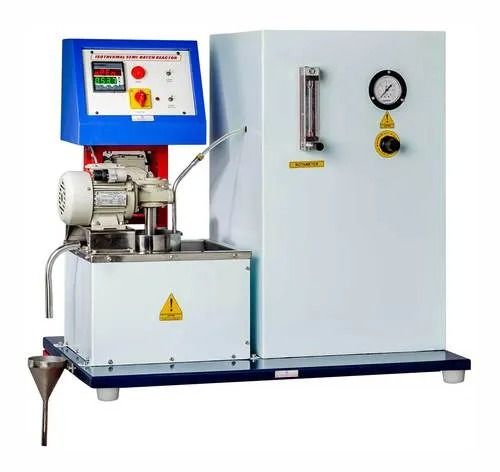
Versatile Plug Flow Reactor for RTD & KineticsDesigned for precise RTD analysis and plug flow studies, this system is equipped with a high-quality borosilicate reactor tube ensuring chemical resistance and observational clarity. Its variable-speed peristaltic pump provides accurate, steady flow control simply adjusted to suit various experimental requirements. Multiple accessible sampling points provide flexibility for in-depth analysis. The setup is well-suited for academic labs and research, facilitating practical demonstration of chemical engineering concepts.
Precision & Safety in Laboratory OperationsWith digital display for flow rate and speed, this reactor system ensures accurate monitoring and user-friendly adjustments. The pump features overload protection and the non-leak glassware design enhances laboratory safety. Quick response times and 2% accuracy in flow rate measurements support robust experimental repeatability, while the easy-to-assemble components speed up setup, cleaning, and maintenance.
FAQs of RTD STUDIES IN PLUG FLOW TUBULAR REACTOR (Straight Tube Type & Peristaltic Pump Feed System):
Q: How is a tracer injected during RTD studies in this plug flow reactor?
A: A tracer (such as dye or salt solution) is injected using the dedicated syringe port near the reactor inlet. This enables pulse or step input experiments, essential for analyzing residence time distribution inside the reactor tube.
Q: What types of experiments can be conducted with this system?
A: The setup supports pulse and step input RTD analysis, flow dynamics demonstrations, and basic kinetics experiments. Its ideal for chemical engineering demonstrations and teaching reactor theory, or for hands-on research in plug flow behavior.
Q: When should the optional water bath be used, and how does it benefit the system?
A: The water bath is recommended when temperature control is necessary, such as for temperature-sensitive reactions or to maintain consistent experimental conditions. It wraps around the reactor tube, helping manage the temperature within the ambient 2030C range.
Q: Where are the sampling points located on the reactor tube?
A: Multiple sampling ports are distributed along the length of the borosilicate glass reactor tube. These allow users to collect samples at different positions, providing data for RTD profiles and flow monitoring.
Q: What is the process for cleaning and maintaining the reactor system?
A: After experiments, flush the reactor tube and associated hoses with distilled water. All connectors, tubes, and glassware are designed for easy disassembly and cleaning without specialized tools, ensuring chemical residues are removed quickly and safely.
Q: How does the variable-speed peristaltic pump contribute to experimental accuracy?
A: The peristaltic pump enables precise, steady flow adjustment in the 0.55.0 ml/min range. Its digital display provides accurate real-time monitoring, ensuring reproducibility and fine-tuning for a wide range of laboratory studies.
Q: What are the benefits of using borosilicate glass for the reactor tube material?
A: Borosilicate glass offers exceptional chemical resistance, clarity for visual observation, and durability under laboratory conditions, making it ideal for repeated, safe use in chemical engineering and academic environments.

 Send Inquiry




 Send Inquiry

 Send Inquiry